Have you ever thought how the biological clock inside every living things are maintained?

Well its quite a interesting story.
The biological compound named Melatonin is responsible for that. Questions comes how? What is Melatonin?
Well to start with the details , lets say,
Melatonin is a hormone( N-acetyl-5-methoxytryptamine ) secreted by the pineal gland in the brain. Many biological effects of melatonin are produced through activation of melatonin receptors, while others are due to its role as a pervasive and powerful antioxidant, with a particular role in the protection of nuclear and mitochondrial DNA. It helps regulate other hormones and maintains the body's circadian rhythm. The circadian rhythm is an internal 24-hour “clock” that plays a critical role in when we fall asleep and when we wake up. When it is dark, your body produces more melatonin; when it is light, the production of melatonin drops. Being exposed to bright lights in the evening or too little light during the day can disrupt the body' s normal melatonin cycles. For example, jet lag, shift work, and poor vision can disrupt melatonin cycles.
Here is the chemical structure of the compound.
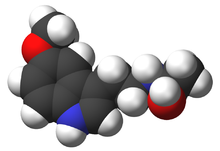
This compound looks something like this in 3d shape -
Some researchers also believe that melatonin levels may be related to aging. For example, young children have the highest levels of nighttime melatonin. Researchers believe these levels drop as we age. Some people think lower levels of melatonin may explain why some older adults have sleep problems and tend to go to bed and wake up earlier than when they were younger. However, newer research calls this theory into question.
Melatonin has strong antioxidant effects. Preliminary evidence suggests that it may help strengthen the immune system.
If you are considering using melatonin supplements, talk to your doctor first.
To sum up the uses of Melatonin , Lets highlight the fields in which Melatonin plays a significant role :-
- Insomnia
- Menopause
- Breast Cancer
- Prostate Cancer
The hormone melatonin is used to treat circadian rhythm sleep disorders and some types of insomnia.
Studies have found that the use of melatonin can help entrain the circadian clock to environmental cycles and have beneficial effects for the treatment of certain forms of insomnia. Prolonged release melatonin has shown good results in treating insomnia in older adults.
Legal availability of melatonin varies in different countries, ranging from being available without prescription (e.g., in most of North America) to being available only on prescription or not at all (although its possession and use may not be illegal). The hormone may be administered orally, as capsules, tablets or liquid, sublingually, or as transdermal patches.

No comments:
Post a Comment